Setting Up a Montessori Toddler Shelf at Home — Without the Pressure
Jul 15, 2025 - Toddler - By Jean-Francois Pypops
Do you ever scroll through social media, see a perfectly curated Montessori toddler shelf, and feel a little deflated? You set up beautiful trays and activities at home, but your toddler completely ignores them.
Let me tell you: that is completely normal.
The Montessori shelf can absolutely have a place in your home, but it’s not everything for a toddler. And it doesn’t need to be.
In this post, I’ll show you how to set up a toddler-friendly Montessori shelf that works for real life, not just for Instagram.
Where the Montessori Shelf Comes From
The idea of the Montessori shelf comes from the 3–6 years old Montessori classroom.
In that environment, children make conscious choices about what to work on. They pick up an activity, bring it to a table or mat, complete it, and return it to its place.
Toddlers, especially under 3, are in a different stage.
They’re in what Maria Montessori described as the unconscious absorbent mind. They explore. They move. They mix things up. They don’t always sit quietly threading beads or pouring water from one jug to another — and that’s okay.
That doesn’t mean the shelf isn’t useful at home. It helps keep toys organized, visible, and accessible. It offers choices. But it won’t necessarily become the heart of your toddler’s day.
Step 1: Set Up a Simple, Accessible Shelf
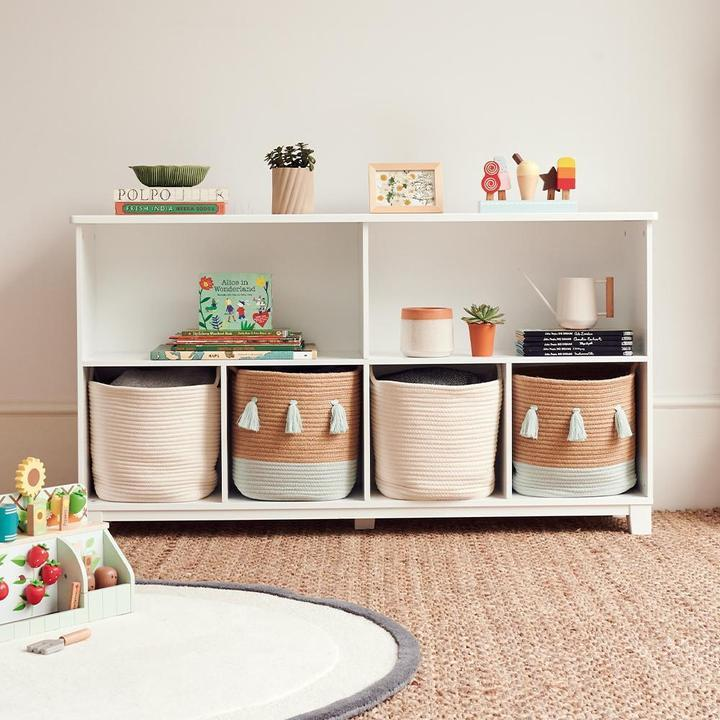
Choose a low, sturdy shelf where your child can see and reach everything. Aim for:
- 6–8 items max: less is more.
- One item per tray or basket.
- Keep it tidy, but don’t stress if it’s not picture-perfect.
What can go on the shelf?
- Practical life toys (e.g., simple pouring, posting activities)
- Open-ended toys like blocks or stacking toys
- Books
- One or two puzzles.
It’s completely fine to mix Montessori-style toys with regular toys you already have at home. In that case, display the toys the same way you would display a Montessori activity. Use a tray or a basket to display duplos for example.

Step 2: Understand How Toddlers Really Use Their Shelf
Now here’s what doesn’t always get shown on social media:
- Some toddlers don’t bring activities to a table or mat.
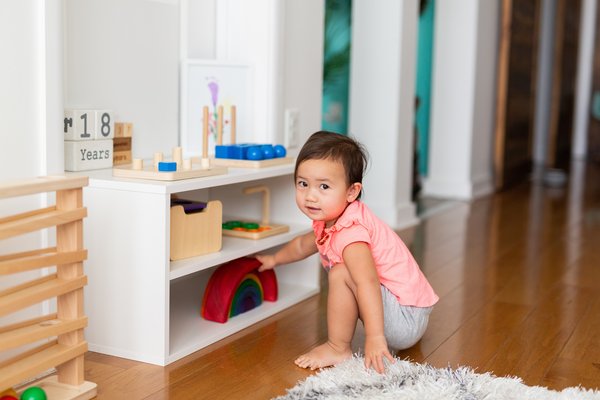
It’s true that in a Montessori classroom, children are encouraged to carry work to a mat. But at home, many toddlers simply prefer to work right at the shelf. They might squat down and play where they see the activity rather than carrying it somewhere else. That’s okay! - Tidying up takes time and practice.
It looks so smooth in videos: a child puts a tray back on the shelf. But in reality, toddlers often leave things scattered around. This isn’t laziness or defiance — it’s because tidying up requires impulse control, memory, and planning skills that are still developing.
That’s why I suggest keeping the shelf simple and uncluttered. Fewer items make it easier for your toddler to focus and make tidying up less overwhelming for both of you. You will have to role model a lot until they are developmentally ready to carry all the steps necessary to tidy up.
Step 3: Rotate Items Gently
Toddlers lose interest quickly — and that’s part of how they learn.
Instead of feeling like you have to constantly rotate everything, try this:
- Observe what they’re actually using.
- Swap out 1–2 items when something hasn’t been touched in a while.
- Leave favourites on the shelf longer — toddlers enjoy repetition!
 LEARN MORE
Step 4: Remember That the Shelf Is Just One Part of Toddler Life
Most toddlers spend their days doing so much more than working quietly at a shelf.
They run, climb, jump, help you in the kitchen, mix toys together, pour pasta from one bowl to another, and wear the bowl as a hat.
From my own experience with my two children, I remember:
- Sliding on our indoor IKEA slide.
- Chasing bubbles.
- Climbing up and down the stairs just because.
- Reading the same story over and over until I knew it by heart.
- Painting with wellie boots.
And not a shelf in sight for most of it.
That’s Montessori too — following the child, not following a shelf picture on Instagram.

Step 5: Focus on What Toddlers Love Most
If shelf work isn’t the centre of your toddler’s world, here are other Montessori-friendly ways to support their learning:
- Physical activities: tunnels, balls, dancing, jumping.
- Language development: reading, singing, chatting.
- Practical life: cooking, cleaning, sorting laundry together.
- Play prompts: Set up a new activity on their table after nap time, rather than leaving everything always available. This was my way to offer activities to my daughter!
Toddlers learn through movement, exploration, and being with you. The shelf is just one tool among many.
 Discover 10 Montessori Principles for parents - FREE video
Subscribe to my newsletter and receive information about my courses, this blog and freebies including the First Lesson of the Montessori Parenting course!
Discover 10 Montessori Principles for parents - FREE video
Subscribe to my newsletter and receive information about my courses, this blog and freebies including the First Lesson of the Montessori Parenting course!
Setting up a Montessori toddler shelf at home doesn’t have to feel like a chore or a performance.
Think of it as offering possibilities — not prescriptions.
If your toddler ignores the shelf sometimes, or always, that’s fine. They’re busy learning in their own way.
I’d love to hear from you: Does your toddler use the shelf regularly, or are they more into exploring the whole house? Share in the comments or join us in the Montessori UK Facebook group!


If you’ve ever wondered why your toddler insists on lining up their toys just so or suddenly repeats every word they hear, you’re likely witnessing...

Toddlers are a bundle of energy, constantly exploring and keen to engage in various activities. Navigating the Montessori principles for the youngest age group can...

What are the pros and cons of adopting a Montessori Floor bed? Most parents interested in Montessori will consider having a Montessori floor bed as...
About the Author: Carine Robin is a qualified and experienced Montessori teacher and founder of The Montessori Family. With over 15 years of experience, Carine offers a blend of professional insight and personal understanding as a mother of two and qualified child psychologist. Inspired by the success of her Montessori subscription box, she created The Montessori Family to provide a comprehensive resource for parents and teachers globally. This platform aims to support child growth and well-being through curated educational activities. Additionally, Carine maintains the UK's most popular Montessori blog and administers the largest Montessori UK Facebook group, making her a central figure in the Montessori community.
